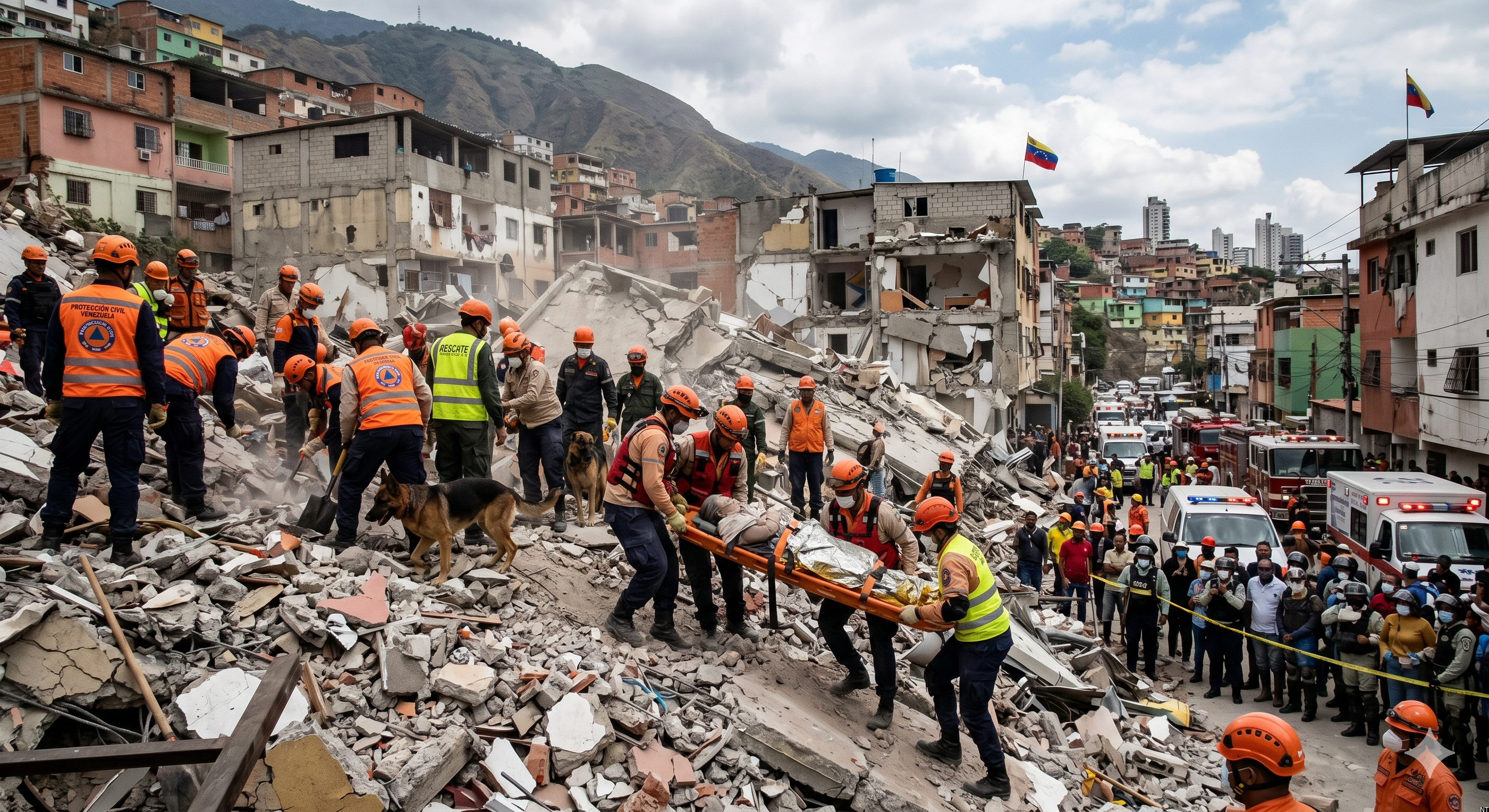
Emergency services in Venezuela are conducting urgent search and rescue operations following two powerful earthquakes that struck the country in rapid succession, causing widespread infrastructural damage and triggering a nationwide state of emergency.
The second tremor, registered at a magnitude of 7.5, stands as one of the most powerful seismic events recorded in the South American nation over the past century. While official casualty figures have not yet been released, authorities have confirmed structural collapses, extensive power and communication blackouts, and the suspension of critical transport networks.
The dual earthquakes occurred within seconds of each other at approximately 18:04 local time (22:04 GMT), coinciding with a national holiday marking the 1821 Battle of Carabobo. According to data from the US Geological Survey (USGS), the initial magnitude 7.2 earthquake originated in the western state of Yaracuy at a depth of 22 kilometres. Just 39 seconds later, a secondary, shallower magnitude 7.5 earthquake struck the same region at a depth of roughly 10 kilometres.
Seismic Timeline & Technical Data (USGS)
--------------------------------------------------
Time (Local):     18:04
Event 1:          Magnitude 7.2 | Yaracuy State | Depth: 22km
Event 2 (+39s):   Magnitude 7.5 | Yaracuy State | Depth: 10km
Aftershocks:      20+ recorded across northern coastline

https://www.youtube.com/live/u6kXkeorfv4?si=8zz4BfvRVNel3QWU
Though the epicentres were located outside the capital city of Caracas, the severe ground motion was felt intensely across the metropolitan area and as far away as Bogotá, Colombia, more than 1,000 kilometres away. The main shocks have been followed by more than 20 aftershocks, primarily impacting Venezuela's northern coastline, including the states of La Guaira, Aragua, Carabobo, and Falcón.
In response to the disaster, Interim President Delcy Rodríguez declared a national state of emergency to mobilize recovery resources and deployment personnel. In a televised address on state media, Rodríguez extended condolences to the families of victims, indicating that fatalities have occurred, though an exact death toll remains unconfirmed.
The infrastructural impact on the capital and surrounding regions is severe. In the Chacao municipality of greater Caracas, Mayor Gustavo Duque Saez reported the total collapse of at least two buildings. Emergency teams consisting of more than 500 rescue workers have successfully extracted 18 survivors from the debris, with operations continuing to locate remaining trapped residents.
"The sheer force of the shaking made it likely there was a high chance of destroyed buildings and deaths." — US Geological Survey (USGS)
The Ministry of Interior has instructed citizens to evacuate residential buildings due to concerns regarding structural integrity and potential compromises to gas distribution lines. To mitigate fire risks, fuel supplies to Caracas have been suspended. The capital is also experiencing extensive internet outages.
Transport infrastructure has been heavily disrupted. Maiquetía International Airport, the primary aviation hub located outside Caracas, has closed due to structural damage. Furthermore, all national metro and rail services have been suspended, and academic classes are cancelled for the remainder of the week.
International aid mobilization has begun. United States Deputy Secretary of State Christopher Landau announced that the US is organizing assistance for the affected zones, while regional neighbors including Brazil, El Salvador, and Ecuador have formalised offers of emergency support.
The USGS highlighted that the affected regions are highly vulnerable to seismic activity due to a high prevalence of structures built from adobe blocks and reinforced brick masonry. Predictive models issued by the agency estimate a 36 per cent probability that the eventual death toll could reach up to 10,000 people, and a 40 per cent probability that it could range between 10,000 and 100,000 fatalities.
An initial tsunami threat advisory issued for the Venezuelan coastline and parts of the Caribbean—including the US Virgin Islands and the British Virgin Islands—has been cancelled by the US Tsunami Warning System after data confirmed no ongoing maritime threat.