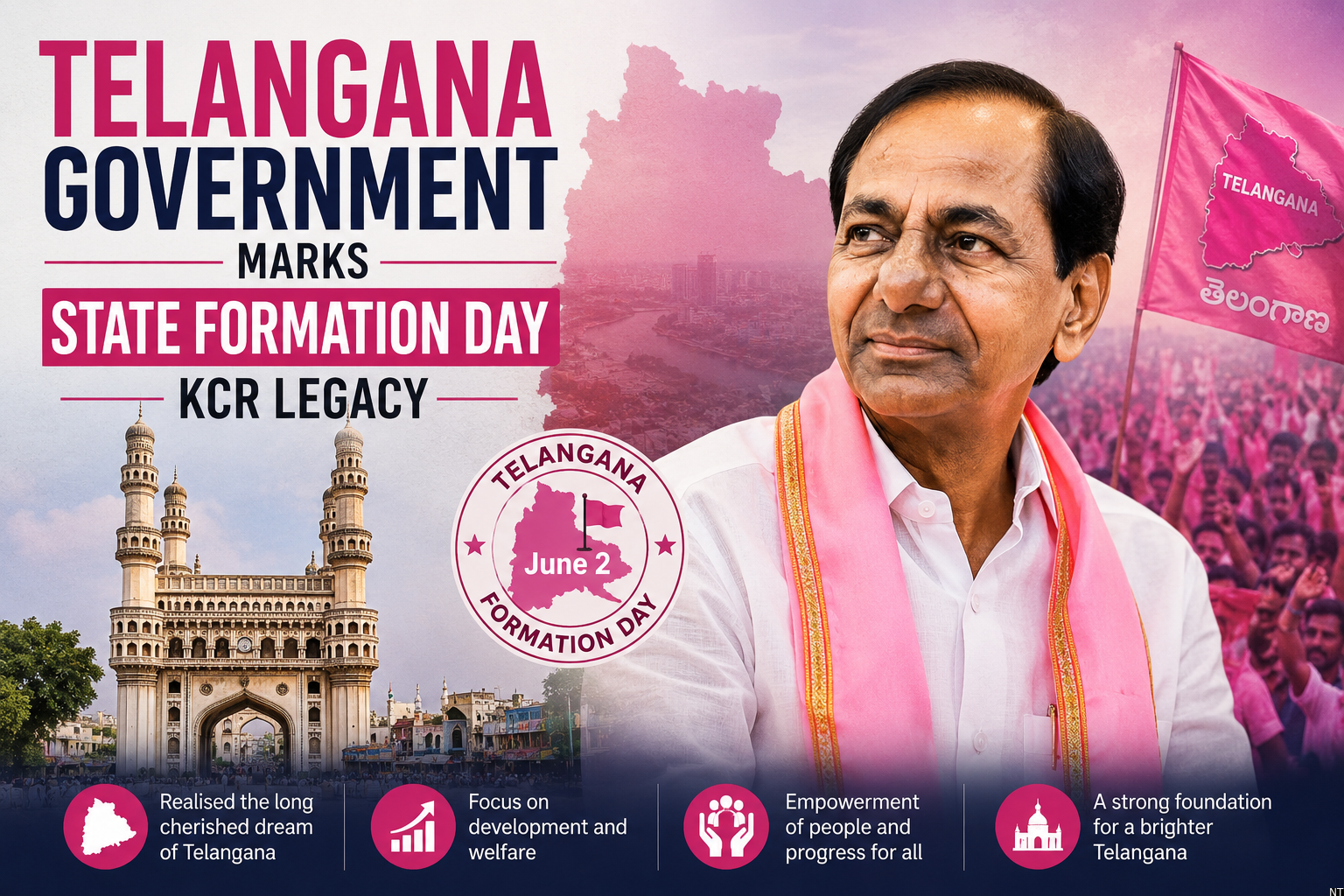
Telangana Government Marks State Formation Day as KCR Legacy Remains Central
Telangana State Formation Day has once again brought renewed attention to the role of former Chief Minister K Chandrashekar Rao (KCR) in the Telangana statehood movement. The latest update comes as political leaders, supporters and citizens reflect on the decade-long journey that led to the formation of Telangana on June 2, 2014. For many, KCR remains a central figure in the movement that transformed a long-standing regional demand into political reality.
The formation of Telangana as India's 29th state followed decades of political mobilisation, public protests and demands for separate statehood. KCR, founder of the Telangana Rashtra Samithi (TRS), now Bharat Rashtra Samithi (BRS), emerged as one of the key leaders who shaped and led the movement through constitutional and democratic means.
Telangana Statehood Movement and Historical Background
The roots of the Telangana movement date back to the 1956 merger of the Telangana region with Andhra to form Andhra Pradesh. Critics of the merger argued that socio-economic and cultural differences between the two regions were overlooked despite concerns raised by the States Reorganisation Commission.
Over the following decades, Telangana activists alleged discrimination in the allocation of water resources, public funds and government employment. These concerns became central themes of the separate statehood demand and continued to influence regional politics.
The first major phase of the movement emerged in 1969, largely driven by students and intellectual groups. Despite strong public support, the demand for statehood did not materialise, leading to years of political uncertainty and public disappointment.
KCR Revives Telangana Movement Through Political Action
A major turning point came in 2001 when K Chandrashekar Rao resigned from his legislative position and launched the Telangana Rashtra Samithi. The move was widely viewed as an attempt to revive a movement that had lost momentum after years of political setbacks.
KCR's leadership focused on mobilising public support while maintaining a constitutional approach. Several large-scale protest programmes, including Sakal Janula Samme and Vanta-Varpu, became defining features of the movement. These initiatives helped expand public participation and kept the Telangana issue at the centre of political discourse.
The movement also relied heavily on electoral politics, with statehood becoming a major campaign issue during local, state and national elections.
Political Negotiations and Centre's Response
As the Telangana movement gained momentum, KCR and TRS leaders intensified their engagement with national political parties and policymakers in New Delhi. The demand for a separate state was raised repeatedly before successive governments and featured prominently in political discussions.
One of the most significant developments occurred in late 2009 when KCR launched a fast unto death demanding progress on Telangana statehood. The protest triggered widespread mobilisation across the region and increased pressure on the Central government.
On December 9, 2009, the Union government announced the initiation of the process for creating a separate Telangana state. Although political and administrative hurdles followed, the movement continued until Parliament approved the formation of Telangana.
Telangana Formation and KCR's Political Legacy
Telangana officially came into existence on June 2, 2014, marking the culmination of a decades-long political struggle. The state's formation is widely regarded as one of the most significant developments in contemporary Indian federal politics.
Supporters of KCR view his leadership as instrumental in transforming the statehood demand into a successful political movement. They credit his strategy, public mobilisation efforts and negotiations with national leaders for helping achieve Telangana's long-standing objective.
As Telangana observes another State Formation Day, discussions surrounding the Telangana movement, KCR's leadership and the state's political journey continue to remain central to public and political discourse. The latest update highlights how the Telangana statehood movement remains a defining chapter in the state's history and a key part of KCR's political legacy.