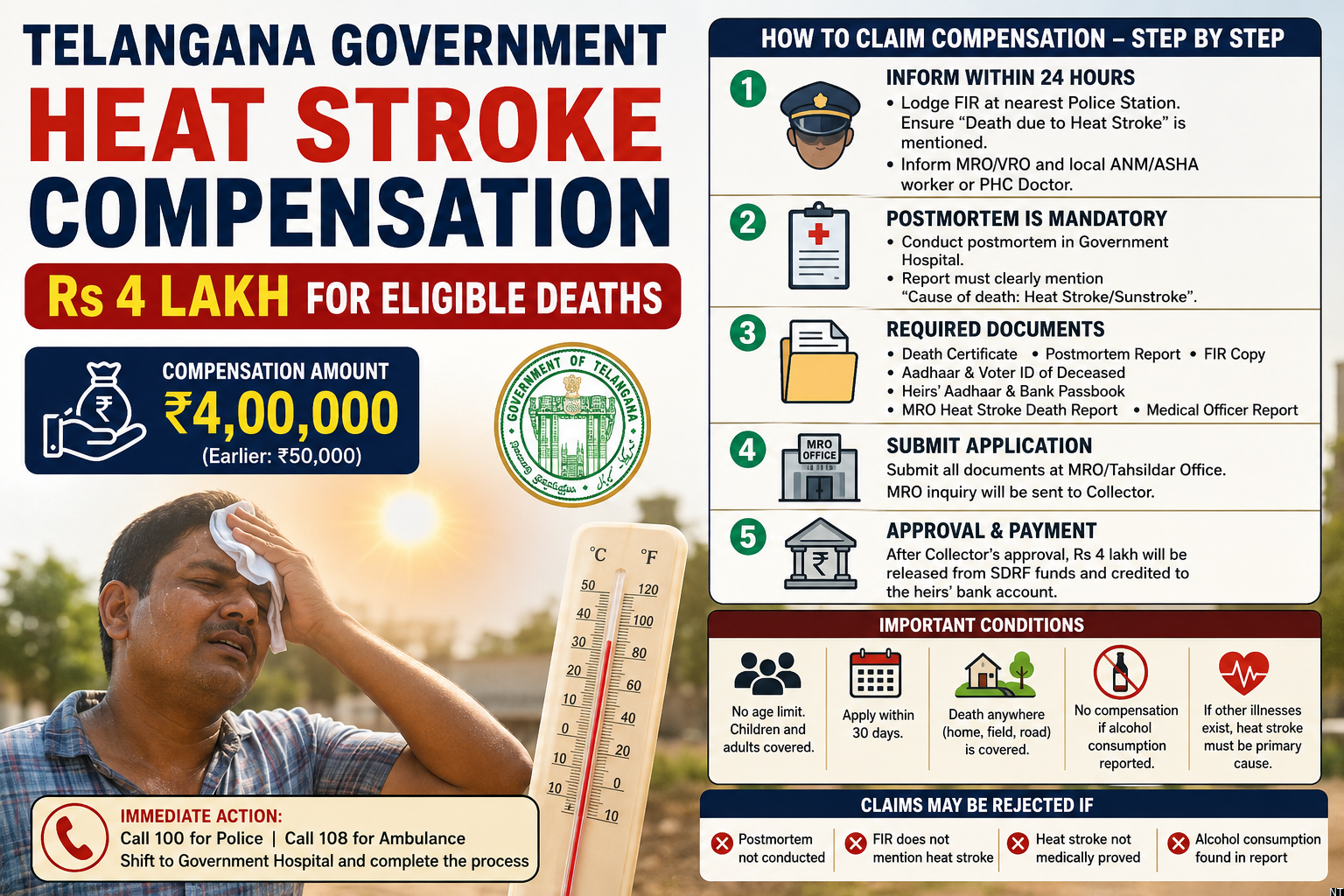
Telangana Government Provides Rs 4 Lakh Heat Stroke Compensation Under Disaster Rules
The Telangana government has classified heat stroke deaths as a natural disaster, making the families of eligible victims entitled to Rs 4 lakh compensation. The latest update is important as the financial assistance has been increased significantly from the earlier amount of Rs 50,000.
Officials have also laid down a clear process for families to claim the benefit. Proper documentation and official verification remain essential for the compensation to be approved.
Heat Stroke Compensation Process and Official Requirements
According to government guidelines, information about the death should be reported immediately. Families are advised to inform the local police station within 24 hours and ensure that the FIR clearly mentions that the death occurred due to heat stroke.
The Revenue Department, including the MRO or VRO, should also be informed. In addition, local health officials such as ANM workers, ASHA workers or doctors at the Primary Health Centre must be notified.
These steps are considered important during the official statement and police investigation process linked to the compensation claim.
Government Rules Make Postmortem Mandatory
A government hospital postmortem is compulsory to establish that the death was caused by heat stroke. Reports issued only by private hospitals are not sufficient for the claim process.
The postmortem report should clearly mention the cause of death as Heat Stroke or Sunstroke. This document forms one of the key pieces of evidence during the verification procedure.
Failure to complete this requirement may result in rejection of the compensation application.
Documents Needed for Heat Stroke Compensation Claim
Families must collect and submit several documents while applying for the assistance. These include:
- Death certificate issued by the local panchayat or municipality
- Government hospital postmortem report
- Copy of the police FIR
- Aadhaar card and voter identity proof of the deceased
- Aadhaar card and bank account details of the legal heirs
- Heat stroke death verification report issued by the MRO
- Medical officer's report
The application should be submitted at the MRO or Tahsildar's office along with all required records.
Collector Approval and SDRF Fund Release
After receiving the application, the MRO conducts an inquiry and forwards the report to the District Collector. Once approved, the compensation amount is released from the State Disaster Response Fund (SDRF).
The sanctioned amount is transferred directly to the bank account of the eligible family members.
Important Government Conditions for Compensation
Government guidelines state that there is no age restriction for this benefit. Children and adults are both covered if the death is officially confirmed as a heat stroke case.
Authorities recommend filing the application within 30 days of the death. If there is a delay, applicants may be required to provide valid reasons.
The location of the incident does not affect eligibility. Whether the death occurs at home, in a field, or on the roadside, the primary condition is that heat stroke must be medically established as the cause.
The rules also specify that compensation may not be granted if postmortem findings indicate alcohol consumption. Similarly, if the deceased had other medical conditions, the medical report should identify heat stroke as the primary cause of death.
Reasons Why a Heat Stroke Compensation Claim May Be Rejected
Government guidelines identify several situations that may lead to rejection of the claim:
- Postmortem not conducted
- FIR does not mention heat stroke
- Heat stroke cannot be medically proved
- The medical report indicates alcohol consumption
Families facing such incidents are advised to immediately contact the police and emergency medical services, shift the victim to a government hospital, and complete the required legal and medical procedures.
The heat stroke compensation process depends on timely reporting, proper documentation, and official verification. Following the prescribed government rules can help eligible families receive the financial assistance available under the disaster relief framework.