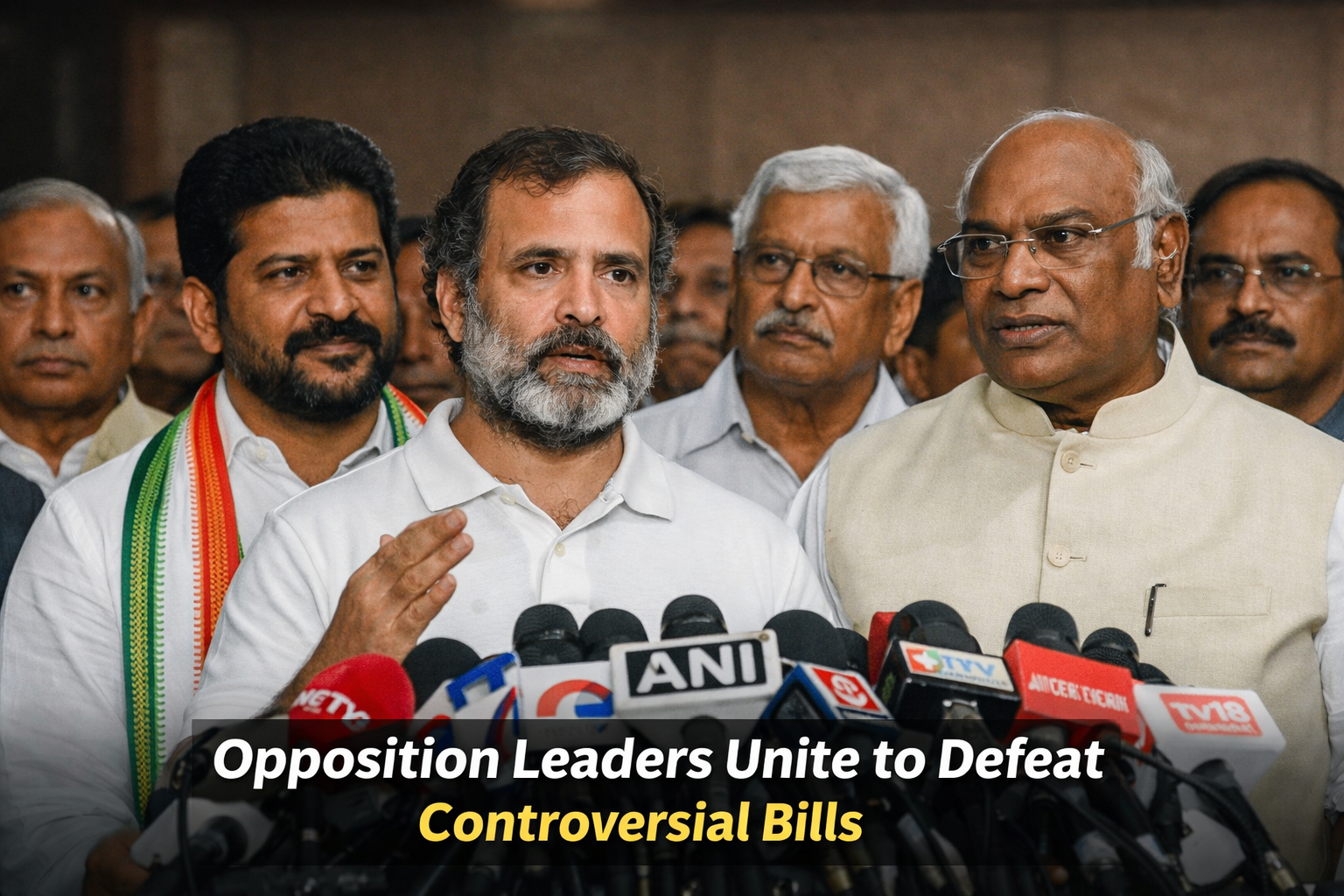
Opposition Leaders Unite, Claim Success in Defeating Controversial Bills
Joint Opposition Response in Parliament
Leaders from multiple opposition parties have stated that coordinated efforts in Parliament led to the defeat of key legislative proposals, describing the development as a significant political moment.
The statement highlighted the role of Rahul Gandhi, Leader of Opposition in the Lok Sabha, and Mallikarjun Kharge in bringing together various parties to oppose the bills.
https://x.com/revanth_anumula/status/2045149728036593743?s=20
Leaders Acknowledge Collective Effort
The response credited several opposition leaders for standing together during the parliamentary proceedings. Among those named were MK Stalin, Mamata Banerjee, Akhilesh Yadav, Sharad Pawar, Uddhav Thackeray, Lalu Prasad Yadav, Hemant Soren, Farooq Abdullah, Naveen Patnaik, and Arvind Kejriwal.
Leaders of Communist parties were also acknowledged for their participation in the coordinated opposition against the proposed legislation.
Political Position on Legislative Outcome
According to the statement, the opposition viewed the defeat of the bills as preventing what they described as a serious national concern. The development has been projected as a result of unified political action across parties.
The leaders emphasised that maintaining collective resistance was central to achieving the outcome in Parliament.
Context of Parliamentary Coordination
The episode reflects ongoing coordination among opposition parties on legislative matters. Such unity often plays a role during voting on major bills, especially when multiple parties align on a common position.
The development comes amid continued political engagement between ruling and opposition benches on key policy issues.
Aftermath and Political Messaging
Following the outcome, opposition leaders have framed the development as a significant moment in parliamentary proceedings. The emphasis has been on unity and collective action in addressing legislative proposals.
The issue is expected to remain part of ongoing political discourse, particularly in relation to coordination among opposition parties in future sessions.