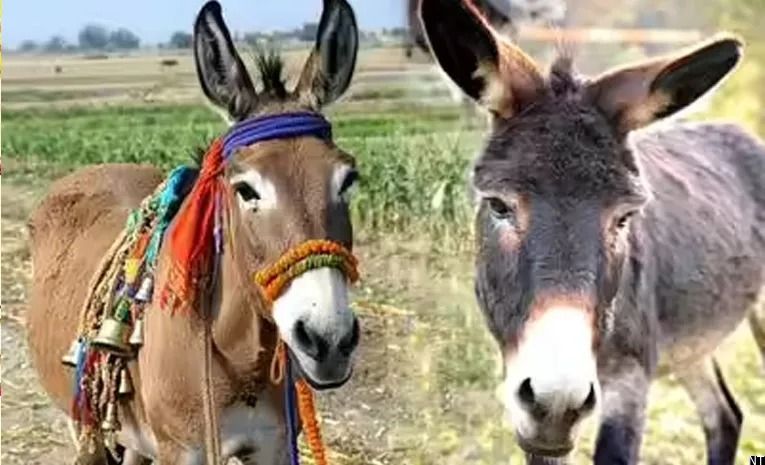
Karnataka Village Holds Traditional Donkey Wedding Amid Rainfall Concerns
Residents of Munyal village in Mudalagi taluk of Karnataka's Belagavi district organised a ceremonial wedding between two donkeys on Sunday as part of a long-standing local tradition believed to invoke rainfall. The event was held against the backdrop of inadequate monsoon rains, with farmers expressing concern over drying crops and the impact of the prolonged dry spell.
The ceremony drew large participation from villagers, who gathered to conduct the wedding according to traditional Hindu rituals. The symbolic event reflected the community's hope that favourable weather conditions would improve and bring much-needed rain to the agricultural region.
In a distinctive feature of the celebration, the male donkey was named "Kantesh" and the female donkey "Kasturi." Villagers performed the marriage with customary rituals, treating the occasion much like a conventional village wedding.
Adding to the uniqueness of the event, organisers printed invitation cards and distributed them among residents, relatives, and well-wishers before the ceremony. The invitations encouraged members of the community to participate in the traditional event, which has been observed in the village for generations.
Following the wedding rituals, a community feast was organised for guests who attended the ceremony. Villagers gathered in large numbers, reinforcing the event's role as both a cultural tradition and a social gathering.
Tradition Linked to Hope for Rain
Village elders said the ritual was conducted because rainfall this year has been insufficient, leaving crops under stress and increasing anxiety among farmers. According to them, conducting a ceremonial wedding for donkeys is a custom handed down through earlier generations and is performed with the hope that nature will favour the region with timely rains.
The elders also acknowledged that there is no scientific evidence linking such ceremonies to rainfall. However, they said the tradition continues as an expression of faith and collective hope during periods of drought or below-normal precipitation.
Across parts of rural India, communities have historically observed various customs and symbolic rituals during difficult agricultural seasons, particularly when rainfall is delayed. Such practices are rooted in local beliefs and cultural heritage, even though they are not supported by scientific explanations.
For the residents of Munyal village, Sunday's ceremony was not only a continuation of an ancestral tradition but also a reflection of the community's shared concern over the farming season and its dependence on a favourable monsoon.