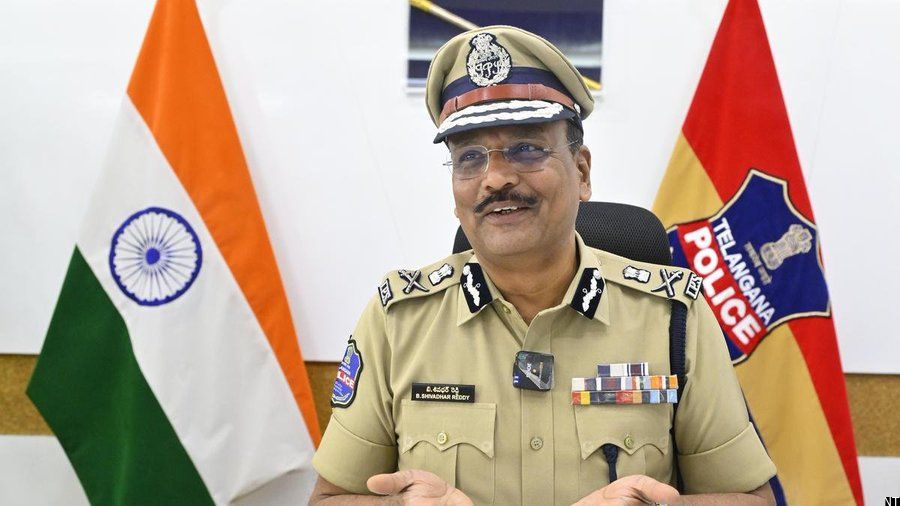
DGP Shivadhar Reddy on Telangana's Evolving Crime Landscape
As his distinguished tenure comes to a close, Telangana's Director General of Police, B. Shivadhar Reddy, has identified cybercrime in Telangana as the single greatest challenge facing law enforcement today. In an exclusive interview ahead of his April 30 retirement, the top cop provided a candid assessment of a state that has successfully transitioned from battling a violent Maoist insurgency to confronting the borderless, anonymous threats of the digital age.
"While traditional crimes have declined, cybercrime has emerged as the biggest challenge," Reddy stated, emphasizing the stability of the state's overall law and order situation, which has seen peaceful elections at every level. He warned that criminals, often operating from distant states, exploit anonymity to siphon funds from bank accounts in minutes, a trend he predicts will remain a primary concern for years to come.
https://x.com/the_hindu/status/2048777872379416856?s=20
The End of an Era: How Telangana Neutralized the Maoist Insurgency
Reflecting on one of his tenure's landmark achievements, DGP Reddy detailed the comprehensive strategy that effectively ended the long-standing Maoist insurgency. He explained that the state's approach evolved from a purely law-and-order issue in the 1980s to a sophisticated, multi-pronged effort combining intelligence-driven operations with crucial developmental interventions.
The creation of elite units like the Greyhounds and the Special Intelligence Branch was pivotal, but Reddy credits a broader strategy for truly winning the peace. "Our success was a carefully calibrated mix of intelligence-driven policing and developmental interventions," he noted. A surrender and rehabilitation policy introduced in 1993 provided a path for cadres to rejoin society, an offer that has seen immense success recently. In the last seven months alone, over 400 Maoists, including top leaders like Devji and Malla Raji Reddy, have surrendered. An open appeal remains for former CPI (Maoist) General Secretary Muppala Lakshmana Rao, also known as Ganapathi, to do the same.
A New Chapter for Formerly Inaccessible Regions
Today, Telangana is free of active Maoist committees and movements. The profound impact of this shift, Reddy explained, is the dawn of a new era for once-inaccessible regions in districts like Bhadadri Kothgudem, Asifabad, and Mulugu. "Roads, electricity, schools, and healthcare facilities can finally reach these communities," he said, highlighting the goodwill earned by facilitating surrenders without bloodshed.
Modernizing the Force for New-Age Threats
With the insurgency contained, the Telangana Police has pivoted to modern threats, leveraging technology and reform to build a more accountable, citizen-friendly force. Reddy pointed to the sharp decline in custodial violence, crediting robust accountability mechanisms like the State Police Complaints Authority.
Technology has become a cornerstone of modern policing in the state. An extensive network of CCTV cameras across Hyderabad and other urban centers has led to a significant reduction in street crime. This is complemented by enhanced forensic capabilities, with dedicated assistants in every district and support from institutions like the Centre for DNA Fingerprinting and Diagnostics.
Reddy also highlighted two other critical focus areas:
- Road Safety: The 'Arrive Alive' campaign was launched to combat the staggering number of road fatalities, which far exceeded murders last year. The initiative focuses on helmet and seatbelt use, lane discipline, and mapping accident-prone "black spots."
- The Drug Menace: The Elite Action Group for Drug Law Enforcement (EAGLE) has been instrumental in bringing the issue of drug trafficking and abuse into the open, making Telangana a leader in tackling this growing problem.
As he prepares to demit office, DGP Shivadhar Reddy's message is clear: the battles of the past have been won, but the future of policing in Telangana will be defined by its ability to adapt to cybercrime, drug enforcement, and road safety challenges, all while maintaining public trust.