Australian Study Finds Evidence of Rare Exploding Stars
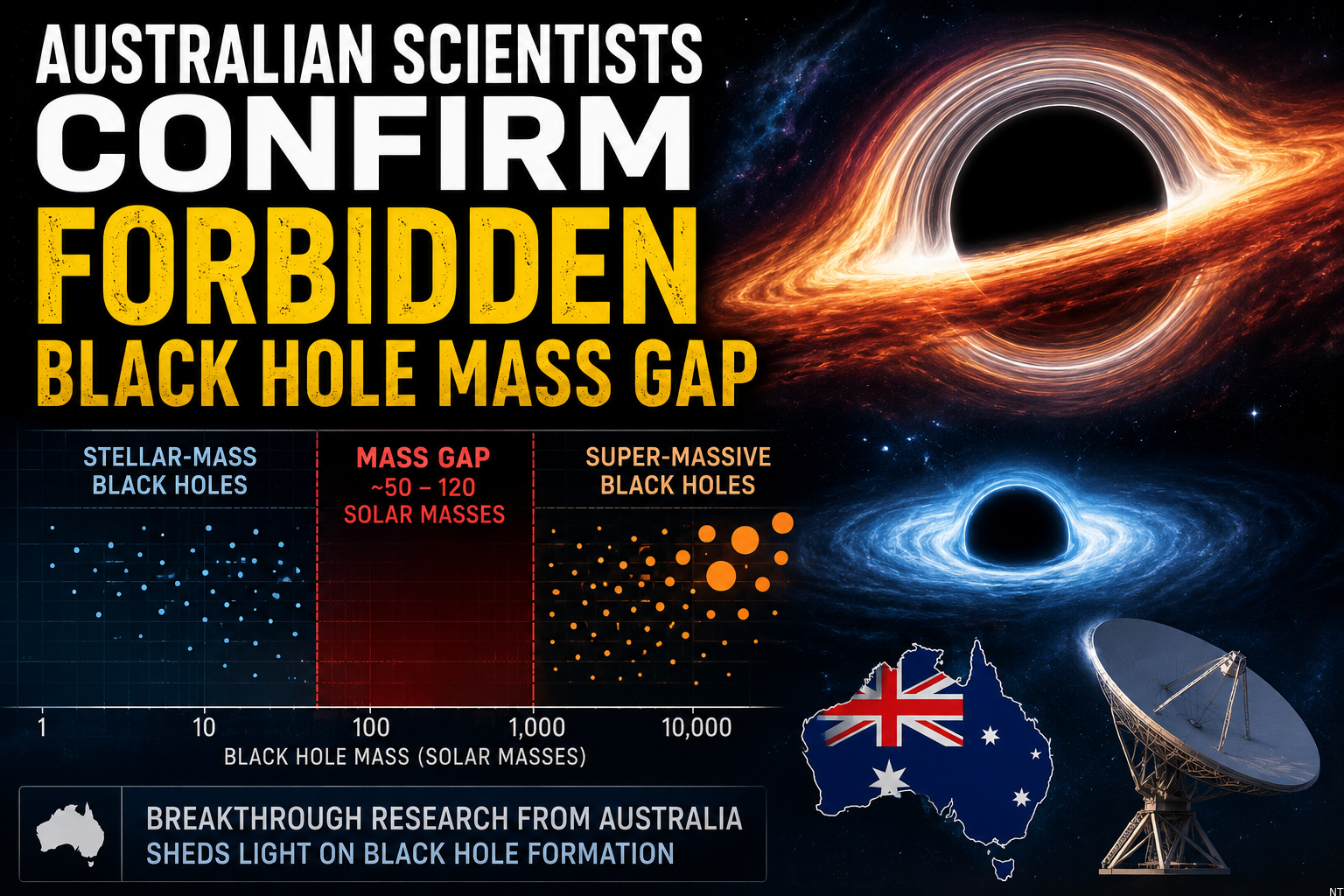
An Australian-led research team has reported evidence of a rare type of exploding star, known as a pair-instability supernova. The findings, published in Nature, provide new insights into how the most massive stars end their lives and confirm the existence of a “forbidden gap” in black hole masses.
Gravitational Wave Observations Used
The study relied on gravitational wave data to examine the final stages of massive stars. Researchers at Monash University explained that while most large stars collapse into black holes, extremely massive stars can reach temperatures so high that they are completely destroyed in a pair-instability supernova, leaving no black hole behind.
https://x.com/Sambad_English/status/2041033181152125083?s=20
Forbidden Range in Black Hole Masses
The team identified a mass range above 45 times the Sun’s mass where black holes formed directly from stars are rare. This gap matches predictions that such stars explode violently and leave no remnants. The only black holes found in this range are believed to originate from mergers of smaller black holes rather than direct stellar collapse.
Researcher’s Statement
Project lead Tong Hui, a PhD candidate at Monash University, said the study strengthens the case for the forbidden mass range. He noted that stars in this category do not produce black holes, and the ones observed are formed through mergers.
Significance of the Findings
Confirming the existence of this gap addresses a long-standing question in astrophysics about the life cycle of massive stars and the origins of black holes. The discovery adds to ongoing global research into gravitational waves and stellar evolution, expanding scientific understanding of extreme cosmic events.